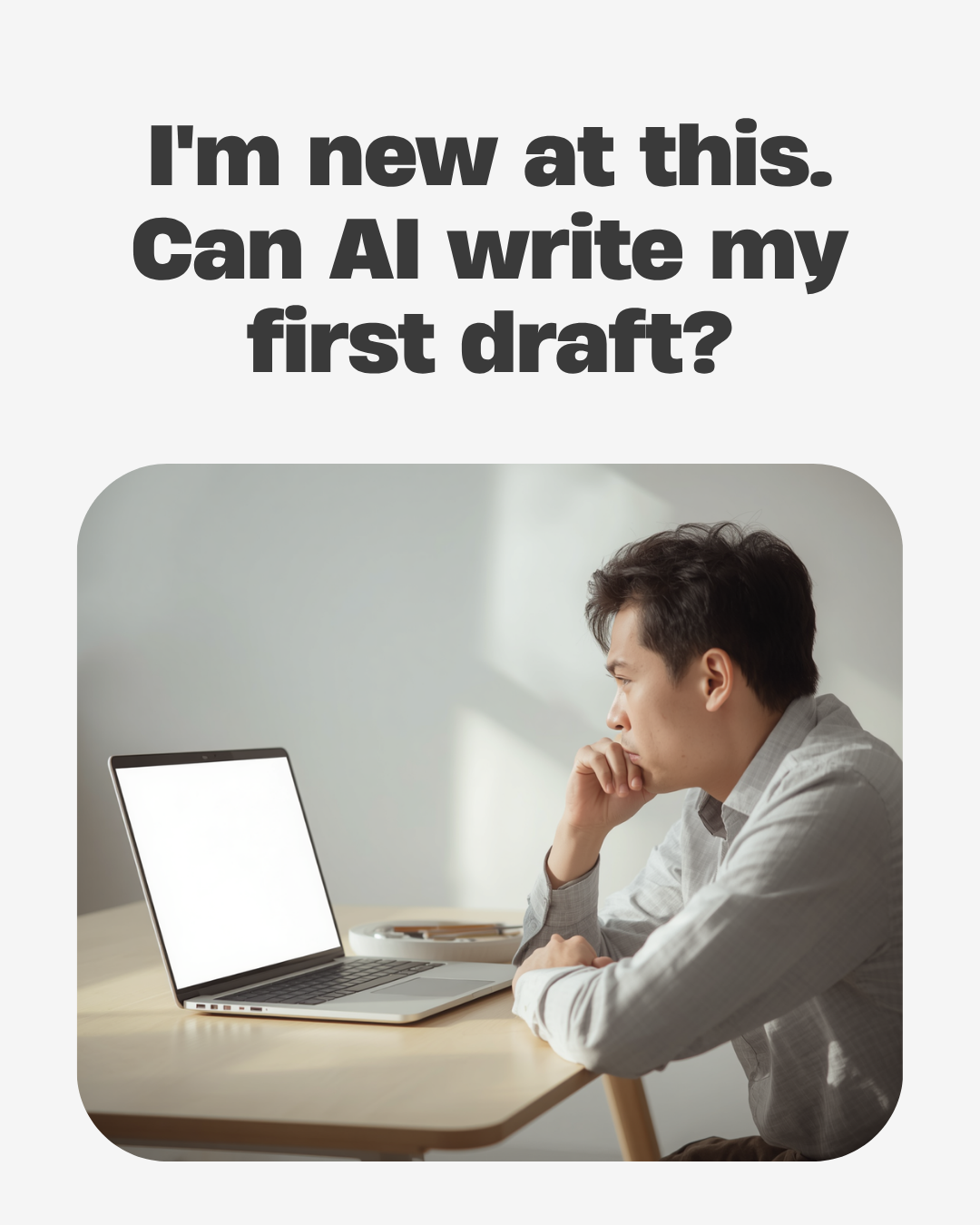
Sometimes the most interesting challenges to my thinking come during one on one conversations with my readers. In one such recent chat, someone questioned my advice about never letting AI write a first draft.
His argument went something like this. (I’m paraphrasing a bit.):
“Easy for you to say. Someone like you with decades of experience doesn’t need AI to write a first draft. But, for someone like me who has way less experience, it can raise the floor dramatically. I can use it to get to a better starting point. What’s wrong with that?”
I offered a two-part answer that will be familiar to readers of this memo.
First, when you forfeit writing, you forfeit thinking. Don’t ask AI to think for you. Far better to ask it to stress test your own thinking.
Second, AI is literally structured towards predictability. Based on how it’s trained, it delivers the most likely next word in each sentence. That drives it away from originality. You’ll end up with a draft anyone else using AI could create – competent, but void of original thought or insight.
Not Very Helpful, Frank!
But then I got to thinking. I realized my “don’t do that” answer was unsatisfactory. I was just explaining why getting AI to write his first draft was a bad idea, not offering an alternative.
Often the best way to offering useful advice is to reframe the question being asked. So, I traced back and restated his original question:
Where does AI fit most effectively, if a creator, especially one with limited experience, is trying to write a persuasive message?
Then I answered in four steps. Today, I’ll skip over my perennial first step: begin by knowing your audience, their hopes, aspirations, fears and pain points. But, in practice, that is always the best place to start.
STEP ONE: Look to AI for research, not writing.
In the creative process, research is probably the place where AI offers the most profound impact. It dramatically speeds up and deepens research. In a recent episode of the Actionable Impact podcast, Jeff Nusbaum, a Partner in the global communications firm BPI, put it this way: “AI is a remarkable, staggering synthesis engine . . . You can use it to unearth facts and figures that a team of people couldn’t do in a million years.”
When I’m writing about a topic I don’t have a great handle on, I start by asking Perplexity or Claude (in research mode) to do things like locate the ten best articles on the subject, list the ten strongest arguments for the case I’m planning to make, or list the ten pitfalls my argument might run into.
STEP TWO: You write the first draft, not AI.
Great research in hand and verified, I write the first draft of the message myself.
I don’t ask AI to write it. So now my starting place is strong AI research filtered through my own thinking and experience. It’s not just an AI article that anyone else could easily create.
As Nussbaum goes on to point out in that same podcast, AI is a great synthesizer, but “In writing, the thing that sticks is the unsynthesized. It’s sort of raw and spiky and unexpected.” And that’s what you lose (or, at best, have to struggle to add in) if you let AI write the first draft.
STEP THREE: Tell AI to play devil’s advocate.
At this stage, I sometimes find it useful to deploy AI in another way. I share my human-created first draft and tell the AI tool to play devil’s advocate with what I’ve written. Where is the flow or logic of my message falling apart? What strong arguments have I overlooked that would strengthen my case? What counterarguments could undermine the case I’ve made?
Claude and Chat GPT are both quite good at this and come at it from different angles. Sometimes, I ask both for their take. It’s a key step because, most of the time, AI is way more insightful when asked to poke holes in an argument than when asked to formulate one.
Using my best judgment, I next edit by responding to the AI input that makes sense and ignoring AI input that doesn’t hold water.
STEP FOUR: Use AI as a junior editor
The final step in my process is to ask AI to play the role of a junior editor reviewing my draft, making suggestions about structure or language. I never ask AI to rewrite what I’ve created with the exception of a “bite sized” new take on a clunky sentence that I can’t resolve.
Why do I call this a junior editor role? To remind myself I never want to treat AI edits like gospel. I just want to consider them, adopting or adapting if helpful and freely ignoring if not.

The key to embracing a significant AI role in your creative work is just like every other AI adoption challenge. You have to make sure it’s a human first/AI forward process.
I’ve laid out my version of such an approach. Try it out on your next message then, if needed, adapt it to better fit your own creative strengths and habits.