by Frank O’Brien
You find the oddest things when you go rummaging through the attic. I stumbled across this quote of mine among some old press clippings. It’s from a 1987 interview when I was running the DNC’s then-nascent direct mail program:
“Liberals use the mail to pay the bills. Conservatives use it to move the country.”
My complaint: Unlike our opponents, liberals and Democrats totally overlooked the communications value of the millions of fundraising messages we were sending out.
It’s still happening and, as we prepare for the 2028 presidential cycle, it has to stop. We have to finally admit that bludgeoning our most committed supporters with daily doses of digital drivel emails and texts is a really bad idea.
And we have to start treating the millions of fundraising messages sent each election cycle as opportunities to motivate and inspire people, chances to genuinely engage them in the drama and excitement of a high-stakes election. Because right now, all they are is nuisances that people reluctantly tolerate in the interest of the larger cause.
A Stunning Contrast: Brilliant Persuasion/Boring Fundraising
Here’s the irony of it all. Democratic digital efforts in 2026 weren’t devoid of imagination and creativity. Far from it. Here are just a few examples of the terrific work digital teams put forward on the persuasion front.
I could go on. But you get the picture. So why the contrast between powerful creativity on the persuasion side and tired, overused tactics devoid of substance in so many fundraising emails? There’s no good answer including the “Look how much money we raised” defense.
The “We Have To Tolerate It for The Money” Argument
No one is more alert than I am to the enormous pressure to meet aggressive fundraising goals in the heat of a campaign. I’ve lived it by working across multiple presidential campaigns for both candidates and party committees.
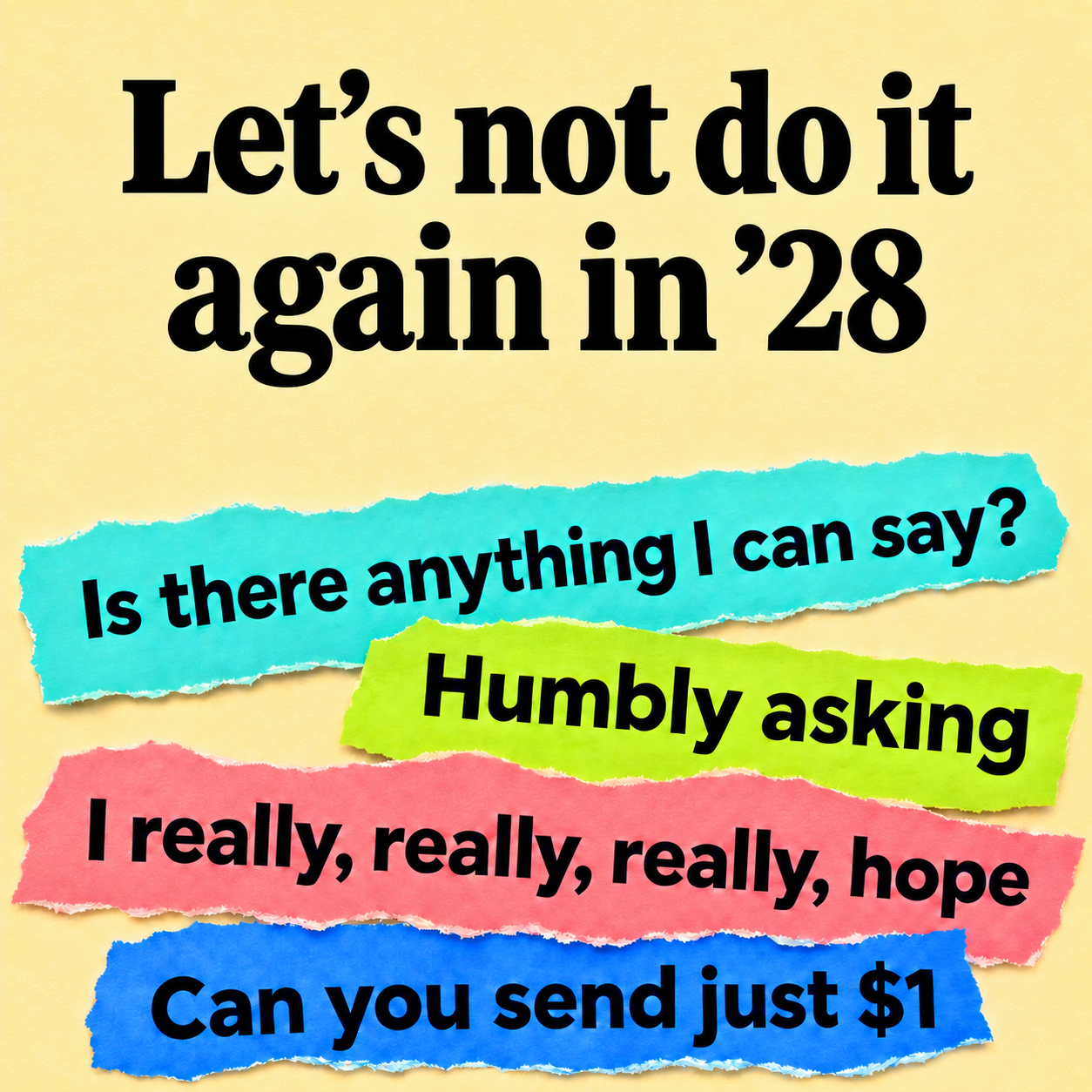
But common sense belies the notion that the only way to run up big fundraising totals is to rely on deeply flawed tactics. The only path to fundraising success can’t be one candidate after another sending the same “humbly asking, is there anything I can say” messages that insult their donors’ intelligence.
It would be a big enough mistake if all that was happening was a failure to use millions of fundraising messages to motivate, engage, and excite people. But deploying that massive communications network in ways that actually frustrate and annoy our audience is blatant political malpractice.
With a little imagination, our 2028 candidates can and must persuade people to donate because of how we engage them, not despite how badly we treat them.
A Better Way Forward
So how do we get from here to there? Let me suggest four fundamental shifts that can move us in the right direction.
#1: Break down the silos between digital fundraising and digital persuasion.
This might be the biggest, most essential step. Right now, in too many campaigns, there’s a divide between the digital teams and agencies focused on raising dollars and those responsible for attracting attention and persuading voters. The fundraisers urgently need an infusion of the energy, innovative spirit, and storytelling ability of their persuasion colleagues.
The divide is already a somewhat artificial one. Whatever their job description, creators of persuasion videos are already playing a fundraising role. While exact attribution would be difficult, there’s no doubt their work is spurring fundraising energy especially among younger audiences. In some ways, that leaves those younger audiences less impacted by lackluster email strategies.
But finding ways to filter some of that persuasion team energy into the email inboxes of older donors who don’t spend much time on YouTube or TikTok would be a real plus.
#2: STOP using techniques as a substitute for a powerful message and START using them in support of one.
It’s a fundamental principle of fundraising communications: Using techniques like deadlines, matching funds and sweepstakes in support of a powerful message is smart strategy. But using those techniques in place of a compelling message is a recipe for disaster.
Restoring that balance between technique and message in Democratic online fundraising would do a world of good.
#3: STOP using static, repetitive appeals and START taking people on an emotional journey through an exciting campaign.
Political campaigns are chock full of dramatic twists and turns. That makes them ripe for emotional storytelling inviting campaign supporters to travel an exciting, emotional journey alongside their candidate. That kind of narrative arc involving movement across time can stoke emotion and emotion drives decisions including decisions to donate.
Evoking the campaign’s narrative and emotional arc doesn’t mean long, involved messages. But it does mean sending messages that uniquely fit a specific moment in time. That storytelling perspective and movement through time is present on the persuasion side. But it’s missing from digital fundraisers whose campaigns rely on a steady diet of static, repetitive, technique-centric appeals.
#4: STOP justifying hammering people several times a day as a necessary evil and START communicating with an energy and frequency driven by how much you have to say.
I’ve saved the frequency of messages for last for a reason. The constant flood of emails and texts is an easy target for critics of current campaign fundraising practices. And the volume is a problem. But the content of fundraising requests is far more critical than their number.
Because of the intensity of high-profile campaigns and the fact that there is an endpoint in sight, people tend to have a higher tolerance for frequent communication in campaigns than in any other setting.
A constant diet of multiple messages a day is hard to defend. But it makes sense to adopt an aggressive messaging rhythm as long as it’s driven by how much you have to say as opposed to how much you think you can get away with.

Just imagine what a sea change it would be if instead of being something people reluctantly tolerated, our fundraising messages deepened peoples’ enthusiasm and heightened their investment in our campaigns.
And think about a 2028 campaign cycle where instead of being a drag on our overall communications strategies, fundraising messages were one of the drivers of a new, more authentic and more effective communications infrastructure.
That’s the change that’s within our reach if Democratic candidates and their campaign’s senior staff demand it.