A while back, I met a guy who has successfully launched dozens of newsletters, print and online. So, I did what I always do when I encounter a person with expertise I don’t share. I asked “What’s the one thing it’s most important to know about succeeding at what you do?”
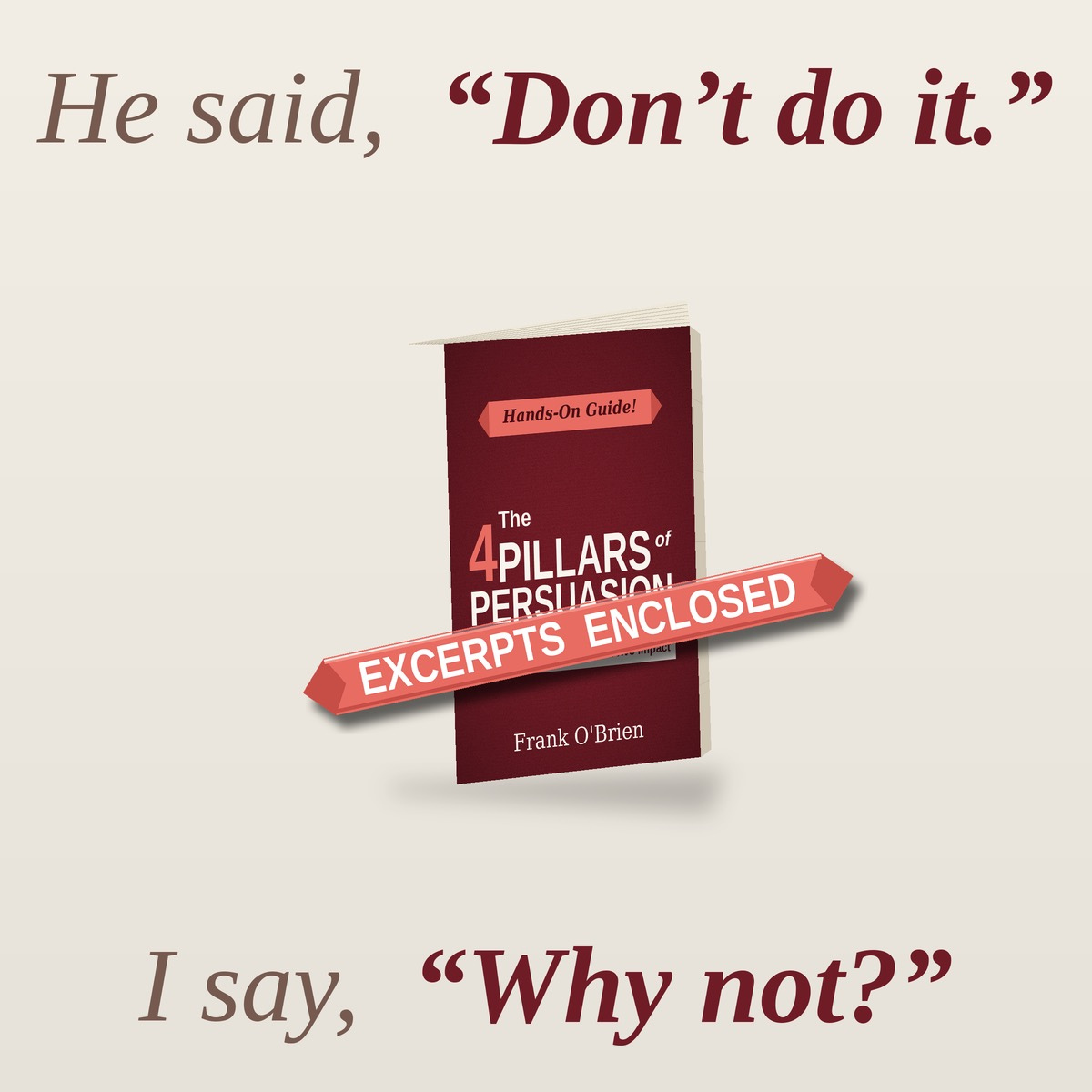
The answer came immediately: “Never send prospects the actual newsletter. Their imagination will always create something stronger than your reality.” It kind of makes sense. But persuasion means knowing when to break the rules. So here you go – excerpts from my new book which will be released tomorrow.
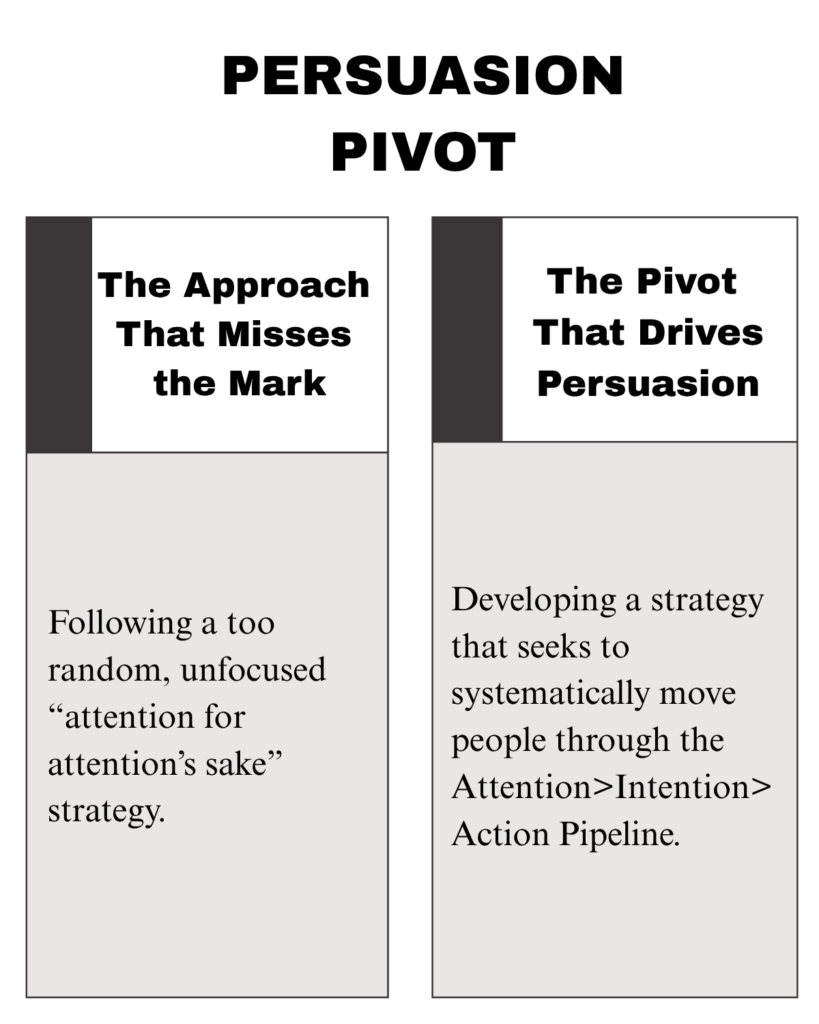
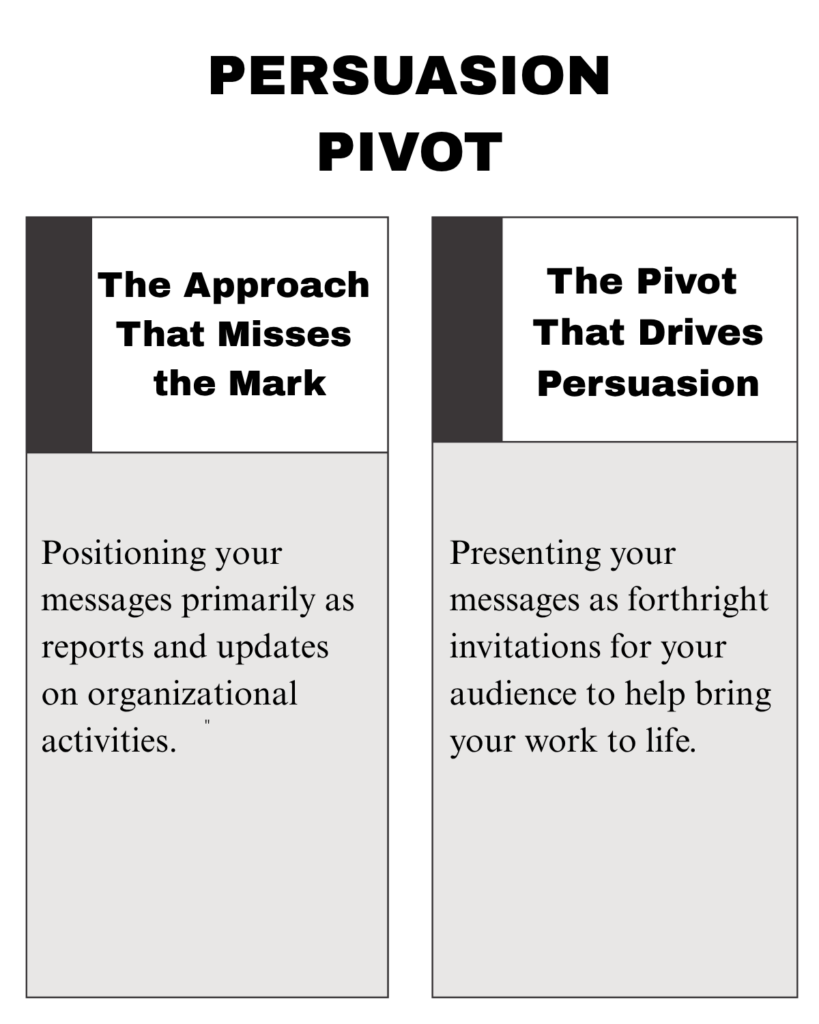
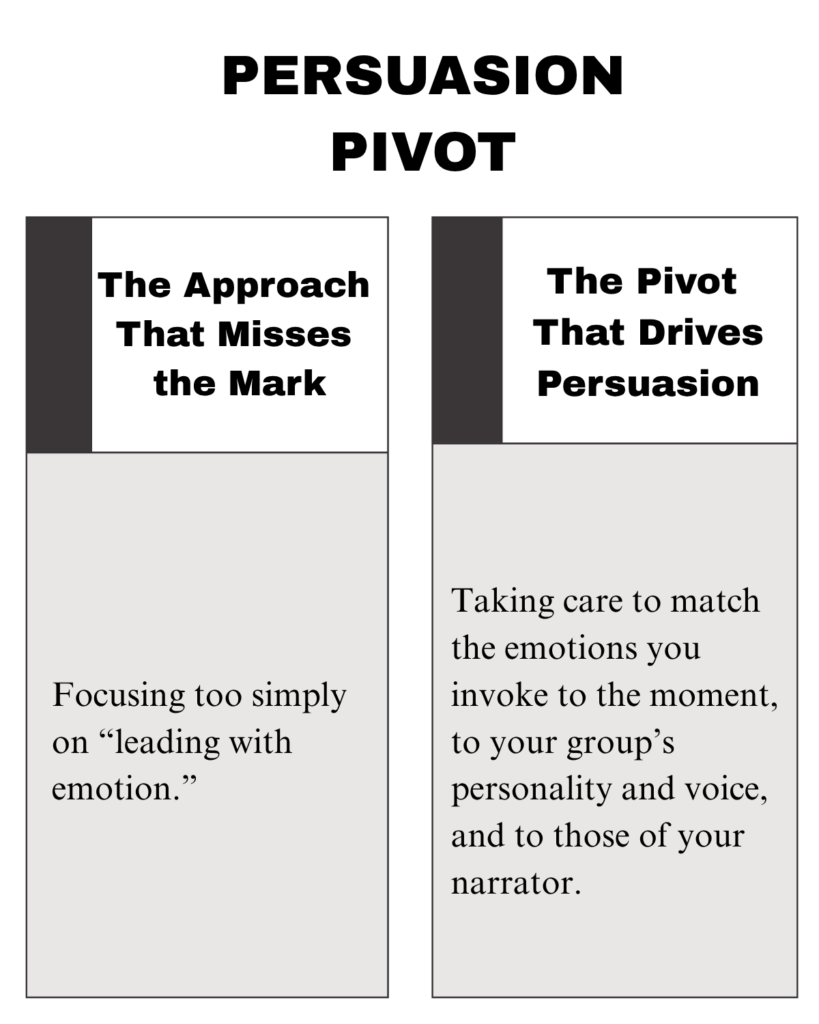
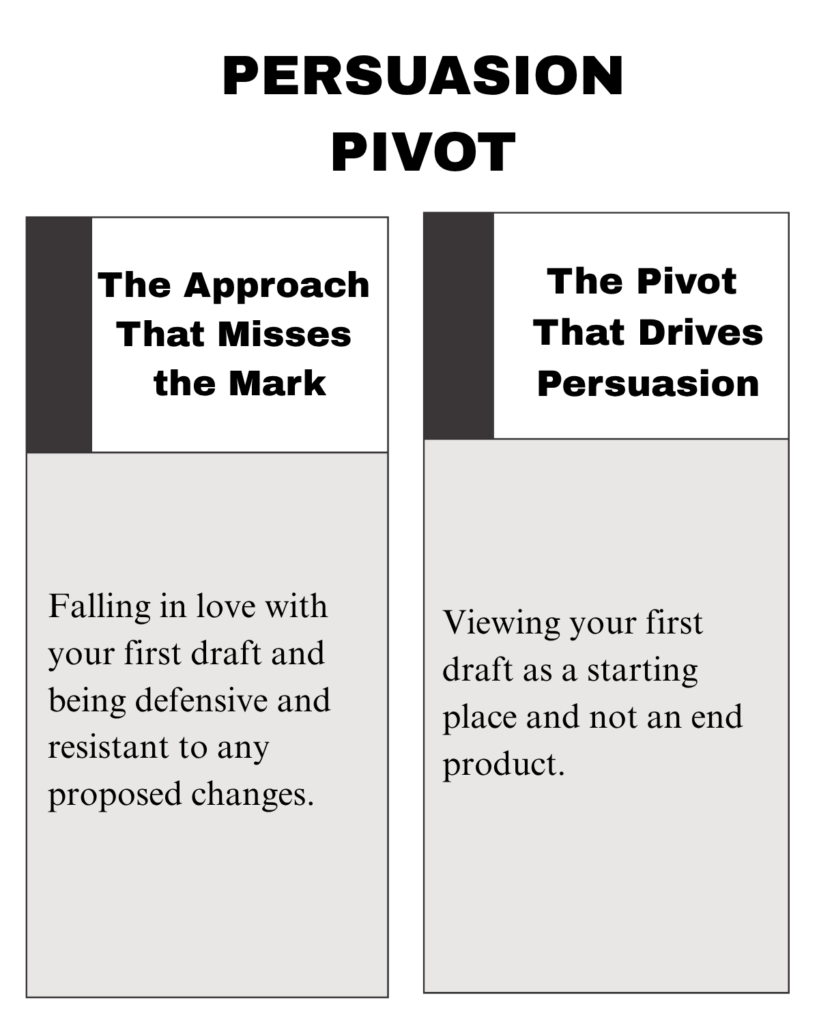
My aim: To give you a better feel for the book’s content and, of course, persuade you it’s worth getting your own copy. For each of the four pillars, I’ve included two or three short excerpts and a Persuasion Pivot – the sometimes dramatic, sometimes subtle, but always consequential shifts from an approach that misses the mark to one that drives persuasion. (There are 27 of them filtered throughout the book.)

Excerpt #1:
“If we want to engage people, we have to first win their attention. And we can only do that by authentically reaching out to them in all the places where attention now lives . . . Our causes and campaigns risk losing connection with their audiences unless we better adapt to how attention is earned, held and funneled into action in today’s rapidly changing landscape.”
Excerpt #2:
“To thrive in today’s crowded, fragmented media landscape, it’s no longer enough to be a distributor of information. You have to be an architect of attention.
Just focusing on “getting your message out” doesn’t work. You have to actively strategize ways to capture people’s attention. That means abandoning sporadic efforts to raise your profile in favor of the nimble, “always on” pursuit of attention.”

Excerpt #1:
“To really gain peoples’ attention you need what commercial marketers call “deep audience knowledge.” What makes them tick? What keeps them up at night? What touches their heart?What drives them crazy?
How will taking the action you’re seeking make them feel? What will it say about who they are?
You can’t answer those questions unless you have a deep, emotionally grounded feel for your audience.”
Excerpt #2:
“When I was creative director of my agency, O’Brien Garrett, I would always sit down to discuss a new project with one of our copywriters. And here’s the first question I would ask:
“Who are you writing to?” Not “What’s this piece about?” Or “What emotions are you trying to evoke?” Or “What’s your line of argument going to be?”
Those are all great questions. But you can’t meaningfully answer any of them without a clear sense of your audience. If you want to get someone’s attention, you better know who you’re talking to.”
Excerpt #3:
“It’s one of the most common pieces of copywriting advice: “Write as if you’re writing to one person.” Sound counsel because the further your message drifts away from that one-to-one conversation, the less authentic it will feel.
That’s why for creative purposes, the understandable marketer’s focus on file segments, voting blocks, and demographic groups has to be handled with care.
The problem is, once a writer starts to think about communicating to a group of people, it pulls the tone and content of the writing away from that feel of whispering something important into the ear of a close friend.”

Excerpt #1:
“While we like to think we’re in control of our brains and all our decisions (and believe we are doing everything as a complex, logical evaluation), it simply isn’t the case,” notes author Melina Palmer, “The conscious brain cannot handle enough information to get through the plethora of decisions needed to survive.”
Despite this reality, many in the nonprofit world hold fast to the conviction that facts, figures and logic ought to carry the day. That’s why so many nonprofit messages seek to win their audience over not with emotion, but with rational argument.
But that’s not really how our brains work.
Frequently, people make decisions in a far more informal way. Then, over time, they develop rational justifications for that initial emotional instinct.
Bottom line: If we want to persuade people to make a decision in our favor, we have to align how we argue our case with the way our brains actually make decisions.
Excerpt #2:
“Our brains are hard-wired to predict what comes next and when we don’t see what we anticipated, we are surprised. That focuses our attention and elevates our emotional reaction.
That’s why of all the emotions we invoke in conversations with our audiences, perhaps the most overlooked is the element of surprise. Ask yourself this: When was the last time you really surprised your audience?
Or try this test: If the recipient of your most recent message tried to, could they pretty much predict the content?
When used thoughtfully, surprise disrupts expectations, captures attention, and opens the door for deeper emotional engagement – all critical steps on the path to persuasion.”

Excerpt #1:
“What’s the biggest difference between your approach to message development and those of other practitioners?”
That’s the question I was asked during the Q and A portion of a recent presentation.
My answer: I actively search out, identify, and confront barriers blocking a group’s ability to persuade people to take action.
This is where the rubber meets the road in the art of persuasion. The key is finding ways to move people from a general sense of goodwill towards your cause to a decision to take the specific action (voting, donating, volunteering, etc.) you are aiming to inspire.
You can’t get there unless you take on the obstacles that are standing in your audience’s way.
Too many communicators wait for barriers to be staring them in the face before dealing with them. But it’s always true that a barrier is much easier to confront in calm waters than in the heart of a storm.
Excerpt #2:
“Don’t use AI to think for you. Use it as a devil’s advocate to stress test your thinking.
Most LLMs present as people pleasers (“Great ideas, Frank. This is going to be a strong memo.”) But often they can be of best use by challenging, testing and refining your ideas. Use prompts telling the tool to
- Test your assumptions.
- Look for flaws in your logic.
- Identify supporting information that reinforces your line of argument.
- Point out facts you overlooked that undermine the case you’re making.
- Find language that is unclear or might be read in two different ways.

There you have it. I hope I’ve given you a productive peek into the content of The 4 Pillars of Persuasion. I’m confident you will find it a worthwhile read. If you agree, take a moment right now to order your copy on Amazon, Barnes and Noble, Bookshop.org or your favorite online outlet.