Okay, “summer reading” might be a stretch. The three publications I’m about to recommend aren’t exactly beach reads. But they are bursting with insights and information to help guide your nonprofit strategies into the fall and beyond.
So here you go – one insightful book, one special report with huge implications for creative teams, and one fascinating Substack memo.
#1: The Book I Recommend
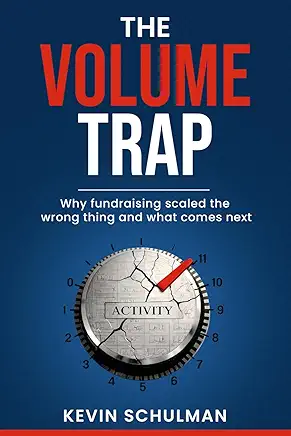
Perhaps I should start with a little confession. I’m a regular subscriber to The Agitator-Donor Voice and I always take delight in Roger Craver’s insightful and wonderfully expressed posts. But perhaps due to my aversion to charts and graphs, I never fully appreciated the wisdom of Kevin Schulman’s take on the state of nonprofit fundraising and communications until I saw it all pulled together in his new book, The Volume Trap: Why fundraising scaled the wrong thing and what comes next.
Read this book and you will never look at your fundraising strategies in the same way again. Like most smart theories of change, Schulman’s insight is both deceptively simple and quite profound. His indictment of current practices centers on a miscalculation at their heart: the belief that if asking works, asking more works even better. Thus, the volume trap.
Schulman doesn’t recommend a few tweaks in program design or creative strategy here and there. He’s calling for “a different operating model; one built on a single insight that the volume machine ignores: people do not give because you ask. They give because giving means something to them.” And our job is “to find out what that something is and to make it easy for them to act on it.”
Kevin and I get there from different angles – me largely through a creative lens, him with a focus on program design and strategy. But we end up emphasizing many of the same themes and approaches: reliance on behavioral science, giving as an expression of personal identity, the importance of deep audience knowledge, a distain for relying on tactics as opposed to seeking out genuine human connection, and more.
Kevin writes with the certainty and passion of a reformer. But he’s got the receipts. Read his book. Let him take you to church and you’ll find yourself looking at your fundraising efforts through different, clearer eyes.
#2: The Report I Want to Draw Your Attention To
“Creative is becoming the new performance driver: Here’s what you need to know, and what to do next”
That’s the title of a fascinating and timely memo by Gwen McGarry, Senior Vice President, Creative at M+R.
The memo takes note of a fundamental shift underway in what drives performance on digital advertising platforms. McGarry notes that for years the main driver was targeting. The smarter and more refined your audiences, the stronger your performance. But now with AI taking a larger role in ad delivery, “Creative is becoming a stronger performance driver than targeting itself.”
The memo doesn’t just explain the dynamics behind the shift. It lays out detailed recommendations for how creative teams can begin to respond to the demand not just for tweaks of creative concepts but for a wider range of distinct ideas.
It’s a future-facing memo that warrants the close attention of both advertising campaign planners and creative teams.
You can find Gwen’s full memo here.
#3: A Fascinating Memo About The
Historical Jesus and Christian Nationalism
My third and final reading recommendation is a memo by Dawn Laguens on her Substack platform “The Digital Picket Fence.” It’s a thoughtful, well-researched piece that explores this question: “how does one of the most dangerous organizers of the ancient world become a mascot for the powerful?”
Laguens examines the hijacking of the historical Jesus’ legacy. “Christian nationalism takes the brand, the cross, the language, the cultural authority, and fills it with the precise things the historical Jesus opposed: worship of power, contempt for the vulnerable, nationalism, wealth as proof of divine favor, religion as a sorting mechanism for who’s in and who’s out.”
So why does all this matter in terms of our politics and culture? Laguens offers the answer (emphasis added).
“I know what some of you are thinking. I’m not Christian. Why should I care?
“Because two billion people organize their moral lives around this figure. Because the most powerful political movement in America right now claims his authority. Because you cannot fight Christian nationalism effectively if you hand Jesus to the nationalists and walk away. And because, honestly, the man had some things figured out that we badly need right now.”
Put it this way. They say politics is downstream from culture and few elements of culture are as influential in terms of values and behavior than religious ones. Here are the closing words of Dawn’s memo:
“The greatest act of resistance available to us might be the simplest one. Take him back from the people using his name to do the opposite of everything he stood for.”

The three readings I have recommended here cover a wide range. But here’s what holds them together. In their own way, each of them equips us to be stronger nonprofit communicators– more alert to the landscape we are operating in and more adept at navigating that landscape in ways that lead to authentic, human connections.