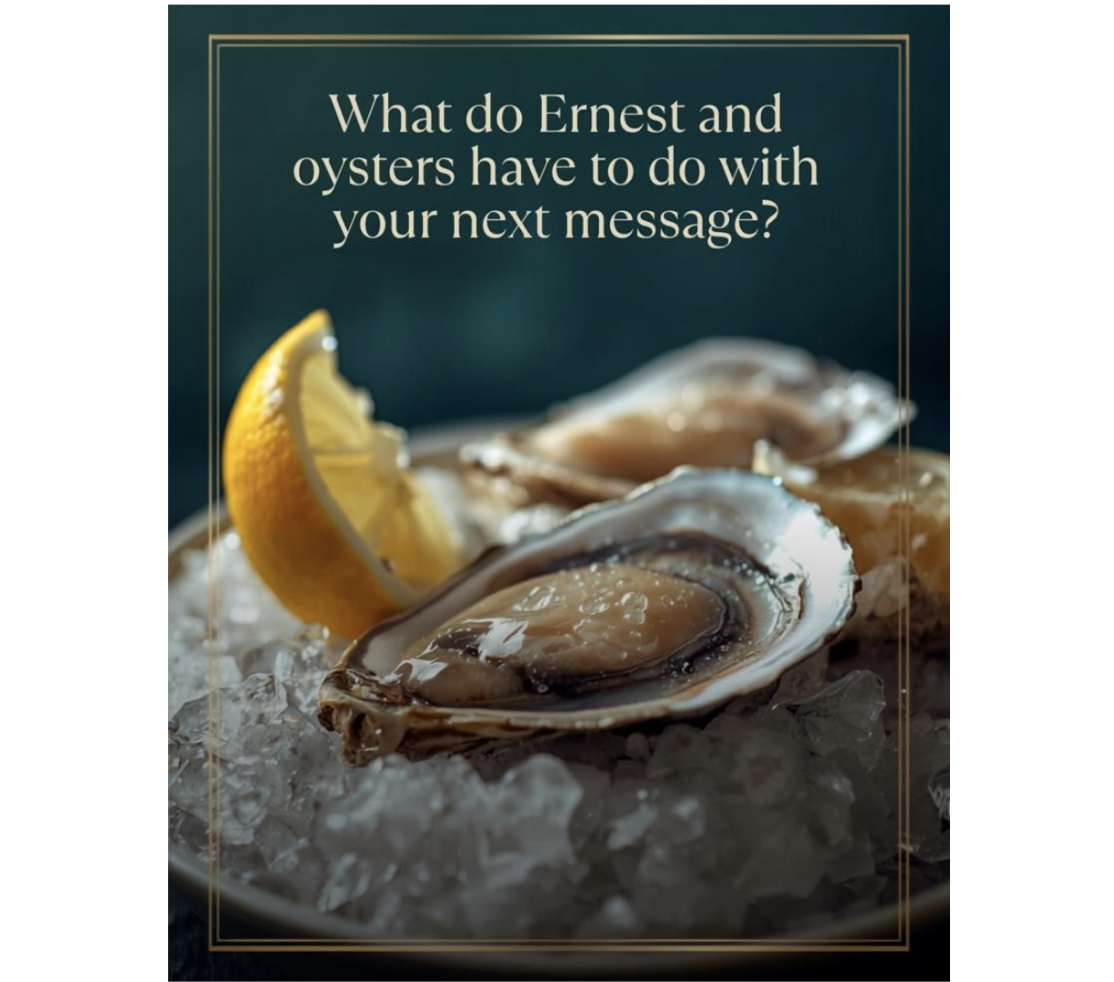
What does Ernest Hemingway eating oysters alone in a Paris café have to do with your next message? Stay with me on this one. The connection’s closer than you think.
Here’s a passage from his posthumous memoir, A Moveable Feast:
“As I ate the oysters with their strong taste of the sea and their faint metallic taste that the cold white wine washed away, leaving only the sea taste and the succulent texture, and as I drank their cold liquid from each shell and washed it down with the crisp taste of the wine, I lost the empty feeling and began to be happy and to make plans.”
Notice how his description draws the reader in with sensory details – the strong taste of the sea and the faint metallic echo, the succulent texture, cold liquid, and crisp tasting wine.
It’s a master class in how to use sensory details to show rather than just tell. The lesson isn’t that your next fundraising email needs to sound like Hemingway. It’s that readers believe and remember what they can experience.
In today’s memo, let’s look at “show, don’t tell” as a core messaging strategy. The science behind it. And some specific takeaways on how to use sensory details to make your next message more persuasive.
“Show, don’t tell” is a strategy, not a style choice
We’ve all heard the advice: “show, don’t tell.” For nonprofit communicators, it means replacing abstract ideas with concrete evidence: not ‘a family in crisis,’ but the unpaid bill on the kitchen table, the coat worn indoors, the parent skipping dinner.”
Copywriting coaches tell people to “Use vivid details.” and “Paint a picture.” Sometimes, it comes across as a matter of taste, some icing on the cake after you’ve made your “real” argument. But the use of sensory details is far more central to your message’s effectiveness than that. It can spell the difference between information your reader registers and a situation they can engage with emotionally, remember, and act on.
Too much nonprofit copy is written almost entirely in the language of institutions and program planners – capacity building, food insecurity, affordability, housing inventories. But on their own, those are abstractions that our audiences, no matter how committed to the cause, have a hard time holding onto, never mind taking action on.
What works better? Not abandoning those abstract concepts, but anchoring them in concrete experiences. And that’s a place where “Show, Don’t Tell,” properly understood, can play an important role. In the hands of a skilled communicator, the linking of abstract concepts to concrete sensory details can lead to a stronger, more lasting connection.
Let’s take a look first at the science, then at the art.
The science behind the power of sensory details
There are mountains of cognitive psychology, neuroscience, and marketing research backing up the wisdom of relying more on sensory details. Let’s just touch on a few highlights:
Abstract words don’t have the same effect. Read “kick” and your brain stirs the muscles it would use to kick. Read “generosity” and not much happens.
That explains the difference between “1 in 5 kids in this county goes to bed hungry” and “Marcus does his math homework with his stomach growling loud enough that his teacher can hear it.” One is received as information. The other gets felt.
Of course, writers from Proust to Hemingway to Flannery O’Connor understood the power of sensory details long before neuroscientists started using fMRIs to scan people’s brains. Here’s O’Connor on the topic:
“Fiction operates through the senses, and I think one reason that people find it so difficult to write stories is that they forget how much time and patience is required to convince through the senses.
“No reader who doesn’t actually experience, who isn’t made to feel, the story is going to believe anything the fiction writer merely tells him. The first and most obvious characteristic of fiction is that it deals with reality through what can be seen, heard, smelt, tasted, and touched.”
But understanding why sensory details work is different than knowing how to draw on them. Here are a few key guidelines on that front.

#1: Search out the abstract and anchor it in the concrete.
“Forty percent of households in the county face food insecurity” is a fact your reader will receive as information, file away and likely soon forget. “The first thing Jasmine noticed wasn’t the empty pantry. It was the silence at breakfast: no cereal hitting bowls, no toaster popping, no one asking for seconds” puts your reader in the room. It’s something they feel. That’s where attention turns into concern, and concern has a chance to become action.”
So, don’t open with “families are struggling through the winter.” Ground your message in vivid details. “The draft slipped through cracks in the windows while the children slept in coats beneath three blankets.”
And don’t write “let me detail our affordability agenda.” First make a deeper, more human connection with “Peter and Angela sat at the kitchen table, staring at the stack of overdue bills. They didn’t just represent money they don’t have. They stood for hope they could pay for their daughter’s college education slipping away.”
Especially in the opening sections of your message, avoid starting with vague abstractions in favor of concrete details that engage your reader’s senses.
#2: Expand out from concrete,
sensory details to the larger picture.
Persuasive messages aren’t just a compilation of concrete images and sensory triggers. You can’t make everything concrete and shouldn’t try. The point is to use sensory details to grab your readers’ attention and engage them with your message. The facts, statistics and next steps will hit harder once you’ve established the emotional stakes. The power is in the sequencing. After a strong concrete opening, the rest of your message can be an interplay between “show, don’t tell” moments and crucial information sharing.
#3: Always use details and locate people’s
stories in an ethical context.
For illustration purposes, I have invented some of the examples used in this memo. But, in real life, the stories you share to “show, not tell” must be authentic ones. And you need to choose details that reveal stakes, context and barriers, never veering anywhere near exploitation or descriptions that undermine the agency of people working with enormous courage to overcome immensely challenging circumstances.
#4: Lean into sensory verbs.
Wherever you feel your message drifting too far into abstract, institutional language, look at the verbs and ask which ones can be replaced by more physical ones that carry the same meaning. Words like grip, haul, scrape, reach, hold can do work that “provide,” “facilitate,” and “engage” never will. And when you’re editing down for space or to improve the flow, cut the adjectives and protect those verbs.
#5: Reach beyond sight.
The sense we all tend to land on is sight. Almost everyone reaches for the visual and stops there. That’s too restrictive. Lean into things like the sound of a roof collapsing during a hurricane; the smell of pancakes, bacon and eggs being cooked at a food pantry; the touch of a rescued dog snuggling up to a child in its new forever home. The fact that sound, smell, and touch are underused actually gives them more power.
#6: Don’t tell people what to feel. Help them feel it. “I know this is going to drive you crazy.” “Here’s the fear we’re all experiencing.” “The story I’m about to tell you will inspire you and lift your spirits.” The problem with sentences like these is that they tell your reader how to feel. An assertion they can reasonably resist.
Use sensory details to describe the situation, then let people arrive at the feeling on their own. When it comes to authentic emotional reactions, inference is almost always more powerful than instruction.
#7: Don’t describe a feeling. Show it.
Don’t say “Maria was proud.” Describe how she jumped for joy when she walked across the stage at her graduation. Don’t say “he was really nervous.” Describe how he changed his route home every day hoping to escape the bullying. Don’t say “they were really worried.” Describe how the parents sat silently for hours squeezing each other’s hands as they waited for the doctor to say if their three-year-old’s surgery was successful.

It seems appropriate to end with a warning. As I hope I’ve demonstrated, vivid sensory details can bring your message to life. Their proper use can turn the oft-stated “Show, Don’t Tell” advice from a stylistic nicety into a core strategy in the art of persuasion.
But like all such strategies, to be effective the use of sensory details must be purposeful. Before you keep a detail, ask three questions: Does it make the stakes clearer? Does it respect the person described? Does it move the reader toward the action we need them to take?
Bottom line: If the sensory detail advances your message’s core idea, deploy it. If it gets in the way and clogs up your message delivery, set it aside.
Already own the book? Leave an honest review.