Recently, I was asked to review and react to a piece of fundraising copy. I made a few language recommendations and suggested a slight shift in structure. But my most important advice was this:
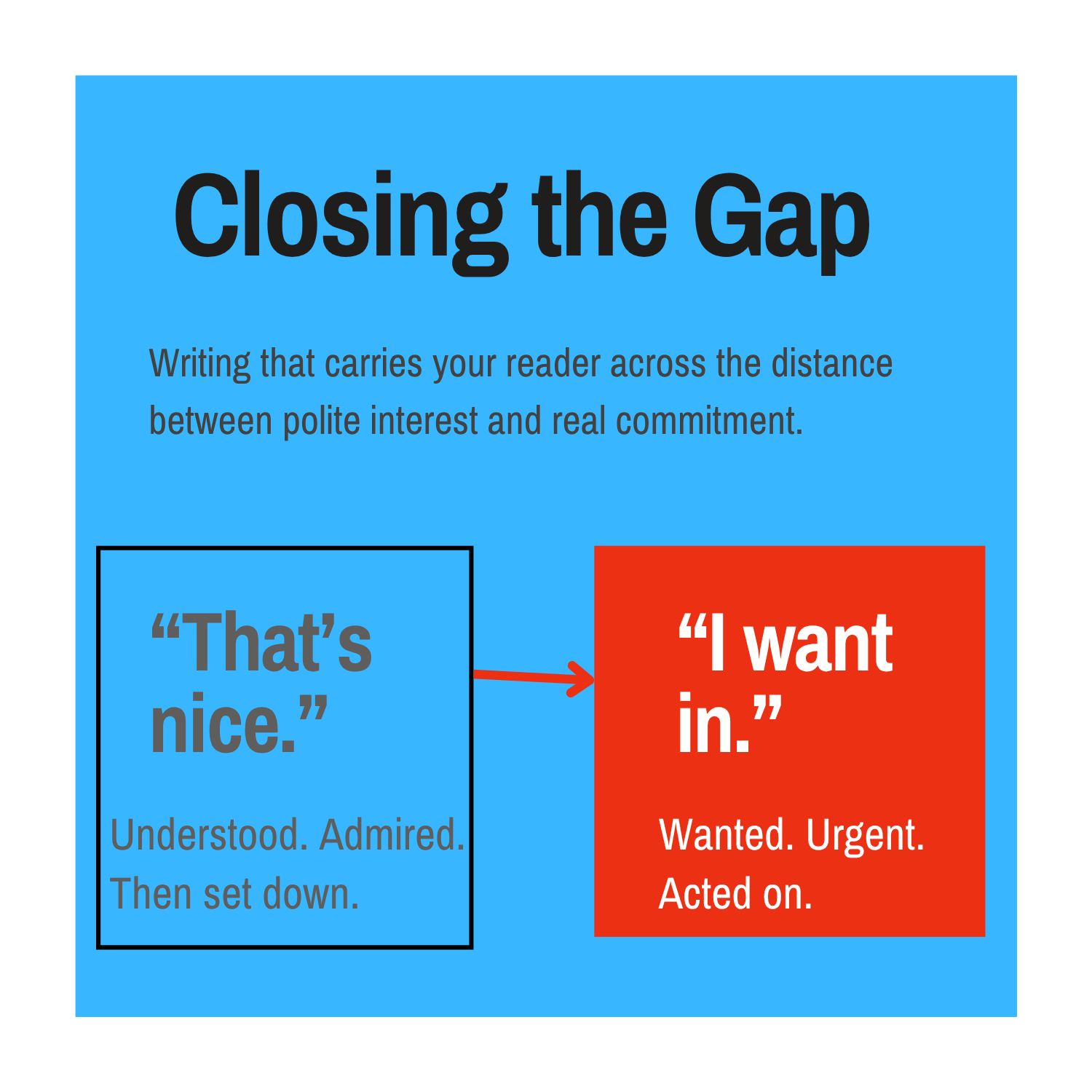
“Right now, this reads as if the likely audience reaction will be ‘Oh that’s nice. This group is doing some good stuff.’ Try to rewrite so that it shifts to ‘Oh, this is important. I really want to be a part of that.”
The more I thought about it, I realized that distinction is actually a pretty good framework for anyone rewriting or editing a nonprofit communication aimed at inspiring action.
Most nonprofit communications that fall short, fundraising or otherwise, aren’t usually hopelessly flawed or glaringly incompetent. They’re just a turn or two away from that interesting to motivating pivot.
In my book, The 4 Pillars of Persuasion, I recounted that when sitting down to discuss a project with a copywriter, my first question is always “Who’s the audience?” You have to know that before you can decipher what about your project will engage people and how taking the action you’re advocating will make them feel?
These questions may not matter on a thank you letter, a trust-building cultivation piece, or an annual report. But, if your immediate objective is to persuade someone to donate, vote, attend a rally, or take another kind of action, getting from a “that’s nice” reaction to “I want in” is the whole ballgame.
In today’s memo, let’s look at five ways to make sure your next piece of copy ends up on the right side of that line.

STEP #1: Search out organization report wording and replace it with audience invitation language.
If you’re filling me in on what your group has been up to lately and what it plans to do next, that’s information I can consume and admire. But if you frame that same content as something you’re inviting me to take part in, now I see things in a different, more engaging light.
Organization Report Language: “Our voter file analysis identified 60,000 Black men in Virginia who turn out in presidential years but not midterms. If we can raise $240,000 in time, our field organizers and volunteers will contact each of them at least three times before Election Day.”
Audience Invitation Language: “We know exactly which 60,000 Black men in this state vote in presidential years and skip the midterms. We have their names. Now it’s up to you. Reaching one of them three times before Election Day costs about $4. With a $40 gift, you can help get 10 more infrequent midterm voters to the polls.”
STEP #2: In fundraising, make the gift a proxy for deep involvement, not a constrained part the reader can play.
One of the offshoots of organizational report language is the (often unintentional) way that it pigeonholes donors into a very limited role. If you describe your work in “what we’re doing back here” terms, it can end up reducing the donor to an on-the-sidelines funder. It’s as if the group is saying “We’re doing some great work and, while you’re not active in that, you can help pay for it.”
Your audience won’t arrive at “I want in” if you’re not really offering a meaningful opportunity to get in. You have to make the action you’re urging them to take a sign of deep involvement, not a drive-by donation.
You can fund it language: “With 56 days to Election Day, our campaign has the right strategy, a strong message, and a massive field organization. All we need now is your financial support and we can win on November 3rd.”
We can do it language: “You and I know how to win elections. Together, we’ve put together the right strategy. We’re delivering a strong message and, with your help, our field organization can keep reaching thousands of voters every day. Your immediate financial support is essential. Let’s keep working side-by-side to carry this campaign to victory.”
STEP #3: Tighten up the time frame to heighten the urgency.
You can be addressing an issue your audience really cares about, making all the most powerful arguments, really connecting emotionally. But you may still not move your audience from “that’s nice” to “I want in” if you fail to address this question: “Why now?”
People are most highly motivated to act in situations where not acting carries severe consequences. If that’s not the case – if holding off for a while seems harmless – then “I can get to this later” becomes an option. Acting affirmatively to close that door by emphasizing “can’t wait” work is usually your best bet.
Leaving the “maybe later” door open: “In Tanzania, you can help us introduce new agricultural methods that mitigate the impact of climate change. As the climate crisis worsens, these new, life-changing techniques become even more critical.”
Acting to explain “why now”: “In Tanzania, you can help us introduce new agricultural methods that mitigate the impact of climate change. With the new planting season right around the corner, we’re in a race to reach as many families as possible with these life-changing techniques.”
STEP #4: Position what’s already achieved as a launch pad for what’s next.
Reporting back is important. It’s essential to let your audience know what their past support has made possible. But if you stop there, you’ve created a cultivation, trust-building message, not one that drives immediate action. If getting someone to do something right now is your objective, you have to use past achievements your audience helped produce as a springboard.
Past Work as Cultivation: “When the hurricane hit, our emergency response teams acted immediately, rescuing hundreds of animals that were left stranded and homeless. Acting quickly, our emergency response teams were able to rescue over 300 dogs and cats. That’s the kind of fast action your support makes possible.”
Past Work as A Springboard: “When the hurricane hit, our emergency response teams acted immediately, rescuing over 300 animals that were left stranded and homeless. Now, we need your help with the next critical steps – reuniting pets with their families wherever possible and finding new forever homes for the others.”
STEP #5: Don’t expect the audience to be excited unless you are.
Excitement is contagious. So is a lack of it. Sometimes, when we write about the same projects over and over again, an unintentional matter-of-fact tone can slip into our language. The balance between facts and emotions leans away from the latter. Rote phrases get repeated and the sense of drama fades. Every sentence doesn’t have to be expressed in breathless prose. But you have to convey immediacy, drama and a sense of consequence.
Matter of Fact Language: “We’ve gone to court 48 times in the last six months to challenge the Administration’s attempt to undo important environmental rules and regulations. With your support, we will continue to protect and defend these essential standards.”
Conveying Excitement: “We’ve gone to court 48 times in the last six months, carrying forward our all-out effort to protect and defend vitally important environmental laws and regulations. We will never yield. Because every time you help us stop, delay or curtail another assault, vital natural resources are protected and hope for a more promising environmental future is kept alive.”

As writing expert William Zinsser noted, “Rewriting is the essence of writing well—it’s where the game is won or lost.” So, it’s important to find the approaches to rewriting that work best for you.
On your next writing project, try putting your copy to the test using the five steps laid out in this memo. I’m betting it will move your draft from one that gets a “that’s nice” reaction to one that generates an “I want in” response.