by Frank O’Brien
With the 2026 campaign season starting to heat up, it’s time to turn our attention to candidate and party messaging strategies. We do because elections, especially these ones, are so consequential.
But for another reason as well: Our nonprofit community can draw important lessons from an examination of how campaigns communicate and how their approaches play out.
So today is the first in a periodic series of “Lessons From The Campaign Trail.” Let’s look at two key dynamics that are defining the 2026 electoral context.

Here’s how Democratic strategist Dan Pfeiffer put it recently: “Attention is the mother’s milk of politics in 2026. Every politician needs it and it’s never been harder to get.” Indeed, understanding the attention economy and how to manipulate it has been a key to Donald Trump’s decade in national politics.
He has understood far better than his opponents that, in our fragmented media landscape, the primary objective is achieving attention dominance. And intuitively he realizes that excessive caution about not attracting negative attention can be a real drawback.
Democrats, on the other hand, play it much closer to the vest. If they sense a risk of attracting negative attention, they often opt for attracting no attention at all. That’s not a winning strategy in today’s climate.
By contrast, we’ve seen Trump flood the zone with one attention-getting moment after another. And before there is time for outrage to mount over one Trump affront, he changes the subject and launches another.
But here’s the thing. In 2026, Trump’s ability to manipulate the attention economy appears to be failing him. That’s for two main reasons (aside from the fact that the President seems to be, in general, off his game).
It’s still playing out. But we may well be seeing a highly successful attention economy strategy failing because its architect has carried it to an unmanageable extreme.


There is another big 2026 strategic and messaging dynamic, but this one cuts against Democrats. Seven months out from Election Day, it seems as if everything imaginable is favoring Democratic prospects.
But there’s one big exception, and it could be the Democrats’ Achilles’ heel. It’s the fact that, while key swing voters are fed up with Trump and Republicans in Congress, they don’t have much faith in the Democratic Party as a solution.
You can see the gap visually in a chart shared by G. Elliot Morris on his excellent “Strength in Numbers” Substack. There’s a 15-point gap between Donald Trump’s net negative disapproval and the Democratic Party’s advantage in the generic ballot question.
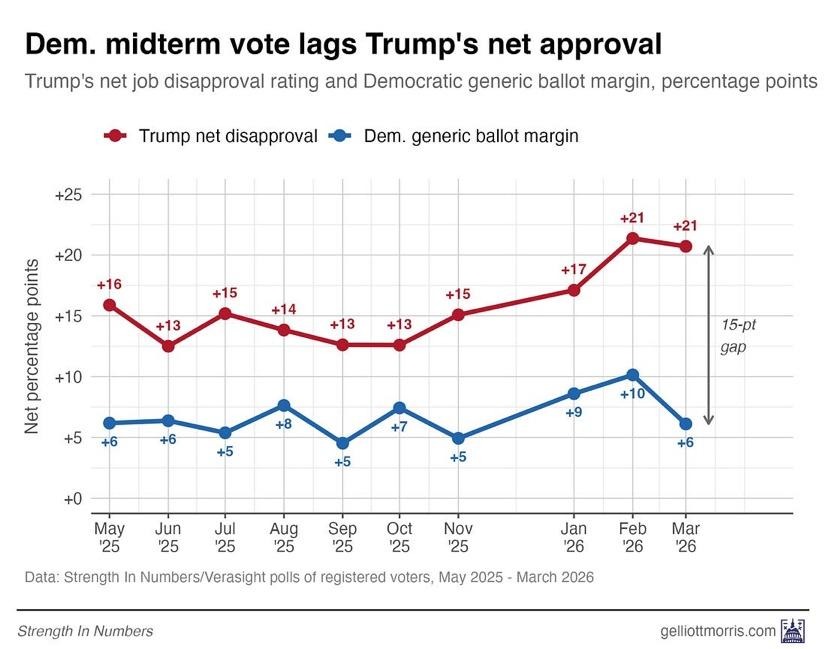
The risk from a Democratic point of view is that the high unpopularity of the party’s brand will prevent November’s results from being as dramatic a repudiation of Donald Trump as his own unpopularity would portend.
These counter-pressures between frustration with Trump and doubts about Democrats will play out differently across audiences. The Democratic base is so fired up that any hesitation about their own party’s strength is unlikely to prevent them from showing up and voting Democratic.
But with swing voters — the people who will decide the most competitive races – those same cross pressures could influence both whether those voters show up and, if so, how they vote.
In the months ahead, we will keep a close eye on two things.
Those answers will go a long way towards determining whether November 3rd is a good night or a great one.


I hope you enjoyed and found useful this first 2026 “Lessons from the Campaign Trail” post. We’ll be checking back in periodically as the campaign season heats up — both to track the high-stakes elections in their own right and to draw broader lessons for non-profit communications.