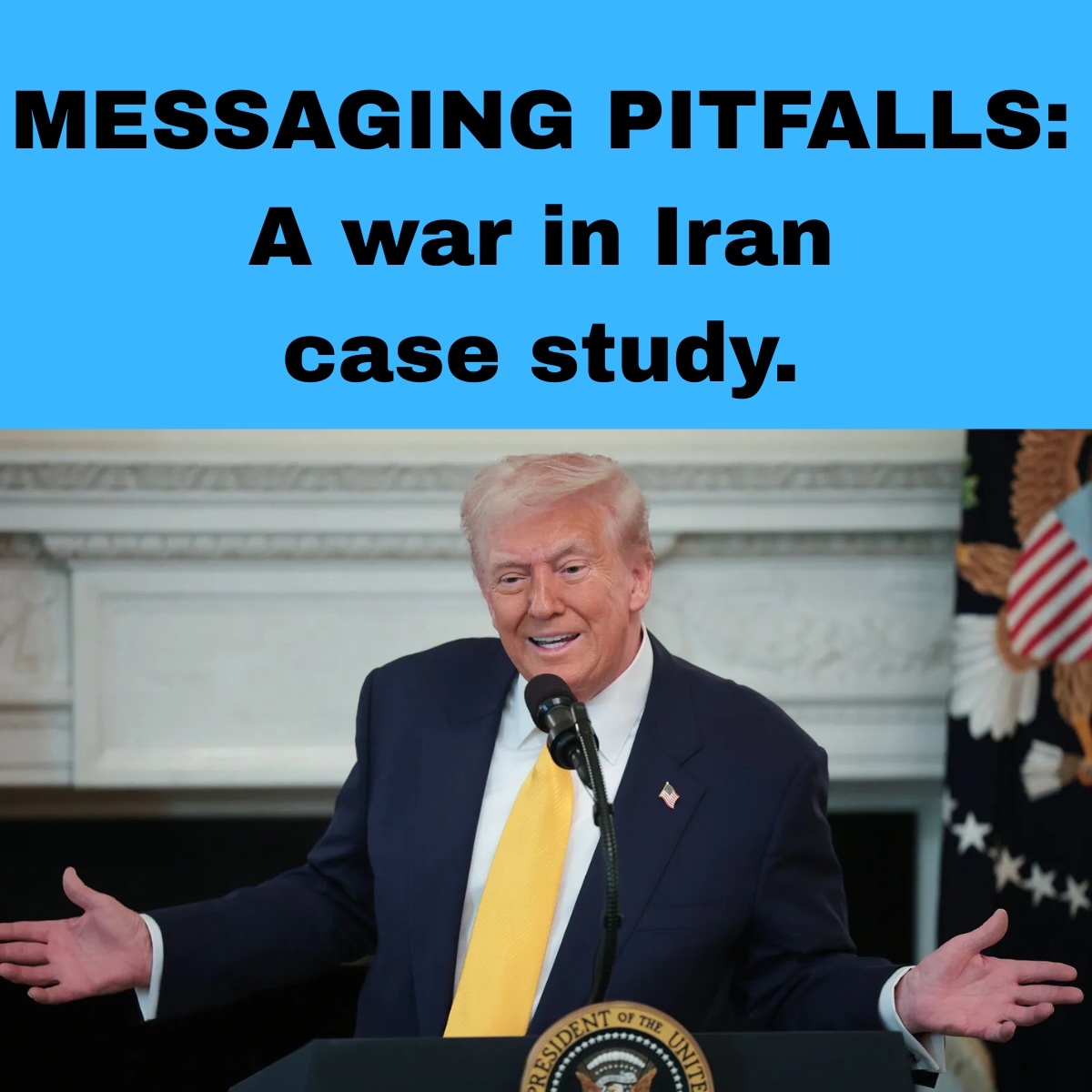
Clear and persuasive messaging is never more important than when a president decides to lead our country into war. And it’s equally important when critics of the president’s action give voice to their opposition. But over the past ten days, we haven’t seen anything like the level of clarity and serious-minded communication that the situation demands.
The Trump administration has offered a stunning array of conflicting, half-baked rationales that have eaten away at efforts to advance a clear narrative. And too many Democrats have stumbled into mumbling and process-centered arguments when full-throated opposition is what’s required.
In today’s memo, let’s look at both sides of that equation — not only in terms of the serious implications for the moment at hand but also as a case study we can apply to other circumstances.

The way Donald Trump and his administration have communicated the rationale for going to war is an object lesson in how not to establish a compelling narrative.
Here is what we’ve seen so far:
No advance message planning: With classic Trump hubris and “trust my gut” instincts, the President and his key advisers appear to have devoted little thought to how they would explain the decision to go to war to the American people. They forfeited the opportunity to establish the defining narrative leaving a vacuum for others to fill.
Offering conflicting rationales. Nothing erodes a narrative faster than the inability to settle on one. It would be concerning enough if different administration figures offered inconsistent storylines. But this time, Trump himself offered multiple conflicting answers to why we needed to go to war.
He came across sounding more like a middle schooler struggling to explain why he didn’t get his homework done, than a president laying out the logic of one of the most fateful decisions of his presidency.
As the competing rationales pile up, they give way to the perception that Trump and his team have no compelling narrative to offer.
Ignoring the optics. We all know what a presidential address at a moment of crisis looks like. The leader of the free world sits behind his desk in the Oval Office and with carefully chosen words explains the situation at hand and lays out a resolute response. Let’s just say a middle-of-the-night Trump video from Mar-a-Lago with his face half buried under a baseball cap was a far cry from that standard.
Failure to define success. Why was it necessary to go to war? What’s our objective? And what will success look like? These are the questions a wartime president must answer. Trump’s failure to do so is eroding trust and deepening opposition to his ill-conceived war of choice.
In a moment, we’ll summarize takeaways to help strengthen nonprofit narratives in high-profile moments, but first, let’s look at the Democratic response to Trump’s war.

If the Trump messaging around the war has been flip and haphazard, Democratic messaging has been all over the map. If ever there was a moment for Democrats to speak with one clear voice, this is it. But instead, we’re seeing too many Democrats mumbling. It’s a pattern that has persisted throughout the first 15 months of Trump 2.0 – often to the frustration of the Democratic base.
As people like Democratic strategist Dan Pfeiffer have noted, we’re seeing too much “hemming and hawing instead of offering full-throated, clear-cut opposition to Trump’s war.”
Broadly speaking, here are the three categories the Democratic response has fallen into, each with a specific example.
The Constitutional Process Argument: Democratic Leader Hakeem Jeffries: “Article One of the Constitution explicitly provides Congress with the sole authority to declare war. There’s nothing ambiguous about that. The framers made that decision because they were concerned about kings who throughout time plunged their people into unnecessary wars impoverishing them or imperiling their lives by sending them off to a foreign conflict… Make no mistake. Iran is a bad actor. They must be confronted for their nuclear aspirations, painful human rights abuses and repression of their own people. But the President has a responsibility to justify plunging America into another war.”
The Bad Strategy Critique: Senator Mark Kelly: “They don’t seem to know what they’re doing or why they did this. I think this is a perfect example of what happens when you have a leader of a country who doesn’t take input, doesn’t take advice, puts a lot of yes people around him. And makes these decisions without the right input, without the right data. So, I think this is not going well for them. And what that means is it’s not going well for our country … They don’t have a plan. I don’t think there was a strategic goal here.”
Full-throated Opposition: Senator Elizabeth Warren: “The Trump administration has no plan in Iran. This illegal war is based on lies. It was launched without any imminent threat to our nation. Donald Trump still hasn’t given us a single, clear reason for this war, and he seems to have no plan for how to end it either. Like a lot of you, I am really angry. I am angry at what Donald Trump is doing and I feel grief for those already killed in this unnecessary conflict. And I will keep doing everything I can to fight to end this war.”


How clearly and persuasively the various parties express themselves in the days ahead will have a powerful impact on the course of Trump’s war of choice in Iran.
We all have a stake in this consequential battle of narratives – and as communicators, we have lessons to learn as that battle unfolds.