We’re only 17 days away from the start of the new year. So it’s high time to zero in on what the 2026 conversation with your audiences is going to look like. In today’s post, 10 questions to consider as you prepare your 2026 messaging strategy.
#1. Are you just rolling into 2026 based on your 2025 messaging?
Especially in volatile times like these, it’s important to be intentional about your messaging strategy. In their personal lives and their philanthropic ones, people tend to see the turn of the year as a time for renewal and re-examination. You may be at odds with that perspective if you end up just treating the start of the new year as a mere continuation of 2025 conversations and activities.
That point is true every year, but it’s especially relevant after a year that your supporters found far from uplifting. You ignore their yearning for a more hopeful reset at your peril.
#2. Do you have a clear picture of your audiences’ mood as 2026 begins?
The best communications strategies focus on meeting people where they are and moving them in the direction you want them to go. That emotional journey starts with a clear understanding of the hopes, fears, energy and aspirations each of your key audiences is bringing to the table.
Early 2026 would be a good time for both formal audience research and informal listening to get as firm a grasp as possible on your audiences’ mood.
#3. What are your biggest barriers to deeper engagement
and higher responsiveness?
Except with cold prospecting or, in the electoral arena, outreach to swing voters, most of your conversations next year will be with people generally disposed to take the action you’re seeking. The line between success and failure lies in how many of them you can move to actually take that desired action.
So it’s a useful exercise to think through for each audience what the main barriers are that stand between that general sense of goodwill and the specific decision to act.
The smartest 2026 messaging strategies will identify those barriers and zero in on ways to overcome them.
#4. What’s different, new and exciting about your 2026 activities?
Especially in the advocacy space, 2025 has seen a lot of static messaging. The details may change, but a lot of messages have fallen into the same template with the same beats. It goes something like this:
Trump is doing something really awful. It’s an uphill battle but we are determined to fight back. We know you may be despairing, but we have to stand fast.
2026 success will come to those who figure out how to break that mold. Look at your program strategies and tactics through a “what’s new and motivating” lens.
Find ways to surprise people – hopeful developments they haven’t caught on to it, shifts in strategy they didn’t see coming.
This is a priority in the advocacy and electoral arenas. But all across the nonprofit world, if you’re in a static messaging rut, it’s vital to look for new ways to break out of it.
#5. What’s the narrative arc as you move through the next year?
As discussed above, static messaging can derive from letting each message you send fall into a predictable and not all that engaging template. But even if you shift that template, the static will continue if there is no movement over time.
Choose to focus on elements of your work that hold the promise of such movement. And test each individual message against this timeliness standard: This message only makes sense at this exact moment in time. It wouldn’t have been possible to send six weeks ago or six weeks from now.
#6. What 2026 conversation can you – and only you –
have with your audiences?
Here’s another test even more important than the timeliness one. Are you sending messages with content that a host of other organizations could send with equal credibility? Or are you carrying on a conversation that you and no one else could sustain?
Think through what’s singularly important about how you tackle a problem and center on that distinctiveness. The double test is: Have you created a message that could only be sent by you and only makes sense in the current moment? The closer you get to that footing, the more solid the ground you will be standing on.
#7. How are you factoring in the midterm elections?
Usually, midterm elections don’t take up anywhere near the space that presidential elections do. That’s not likely to be the case in 2026. Next year’s midterms are taking shape as a crucial test of Donald Trump’s hold on the nation. A strong Democratic showing will be seen as a rebuke of Trump turning him into a weakened lame duck for the second half of this presidency.
By contrast, if Democrats fail, Trump’s power will be reinvigorated in ways that have dramatic consequences. With the stakes that high, donor and voter attention on the elections is likely to run high.
How much that matters, of course, depends on whether your group is in the electoral, advocacy, or charitable arena. Charitable groups will face mostly a calendar concern. It would be wise for them to plan for their audiences to be somewhat distracted in the July to November period.
It’s also logical for advocacy groups to frontload their most important work and highest response expectations in the first half of 2026. And they should be sensitive to electoral mood shifts to impact their audiences.
And everyone should be planning now for a 2026 year-end that will happen in the shadow of the electoral outcome.
#8. How will you get peoples’ attention in 2026?
I’ve written recently about the attention economy and the shifting media landscape we are all operating in. Suffice it to say here that both Donald Trump’s media dominance and the midterms will make the competition for audience attention as difficult as ever.
Every 2026 message you create should be crafted with an eye towards its ability to break through. Safe, run-of-the-mill messages won’t pass the test.
#9. What will you do with that attention once you gain it?
Here’s the other side of the competition for attention. It’s going to be hard to gain it. So when it happens – when you’ve got people focused on your work – you have to make the most of it.
Smart attention economy strategies are double-edged. They plan on ways to gain attention. But they also pre-plan for ways to funnel that attention into deeper conversations and longer-term engagement when it arrives.
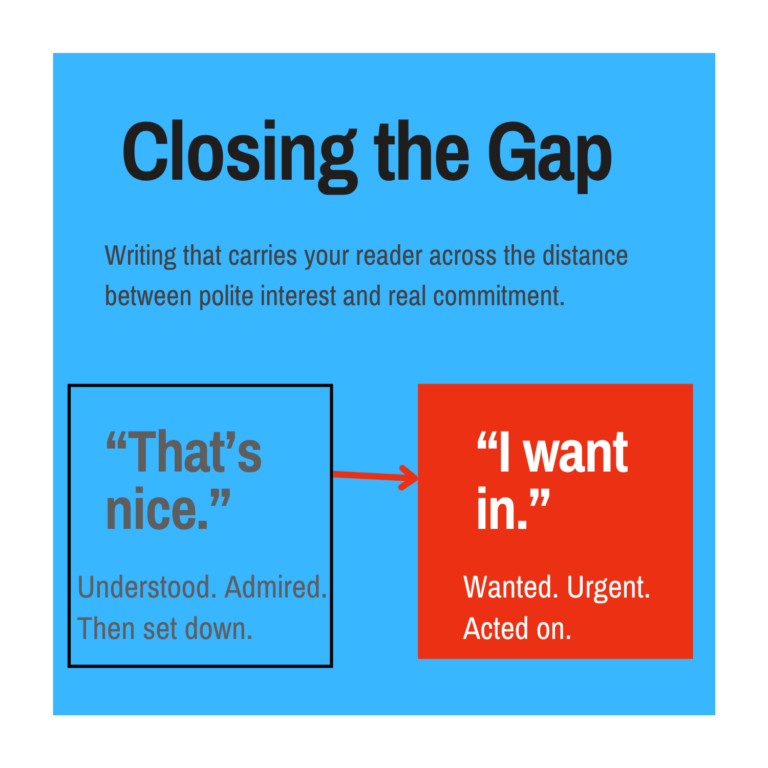
#10. Are you preparing to make a case for your organization’s work or to offer an invitation for your audience to engage in that work?
One final, critical dynamic to focus on as you prepare your 2026 messaging. Too many 2025 messages have been crafted in ways that mainly make a case for the group’s work. The approach unintentionally creates distance between the group and the audience. The message feels like “We’re doing really great work over here and we’re offering you a limited role in supporting that work.”
Here’s the rub. People take action – donating, voting, volunteering, etc. – as a way to express their personal identity. It’s about who they are and how committed they are to taking actions that affirm and reinforce that identity.
2026 messages that genuinely invite people to engage with your work as a way to express their identity will connect far better than organization-focused messages that tag on a limited opportunity to support it.

The coming year is going to be both vitally important and quite challenging. Hopefully, thinking through these 10 questions will help you prepare a powerful, persuasive messaging strategy that matches the moment.


All great points, Frank, especially #6. Creatives who don’t invest time and thought answering this question have always left strategic messaging opportunities on the table. With audience attention and trust in short supply, everyone needs to be doing this!