When we’re communicating with active supporters or like-minded potential audiences, it is often safe to assume a general sense of support for our causes and campaigns.
The trick is moving as many people as we can through a series of funnels. First, we need to turn that general sense of goodwill into a specific intention to donate, volunteer, attend an event, vote, etc.
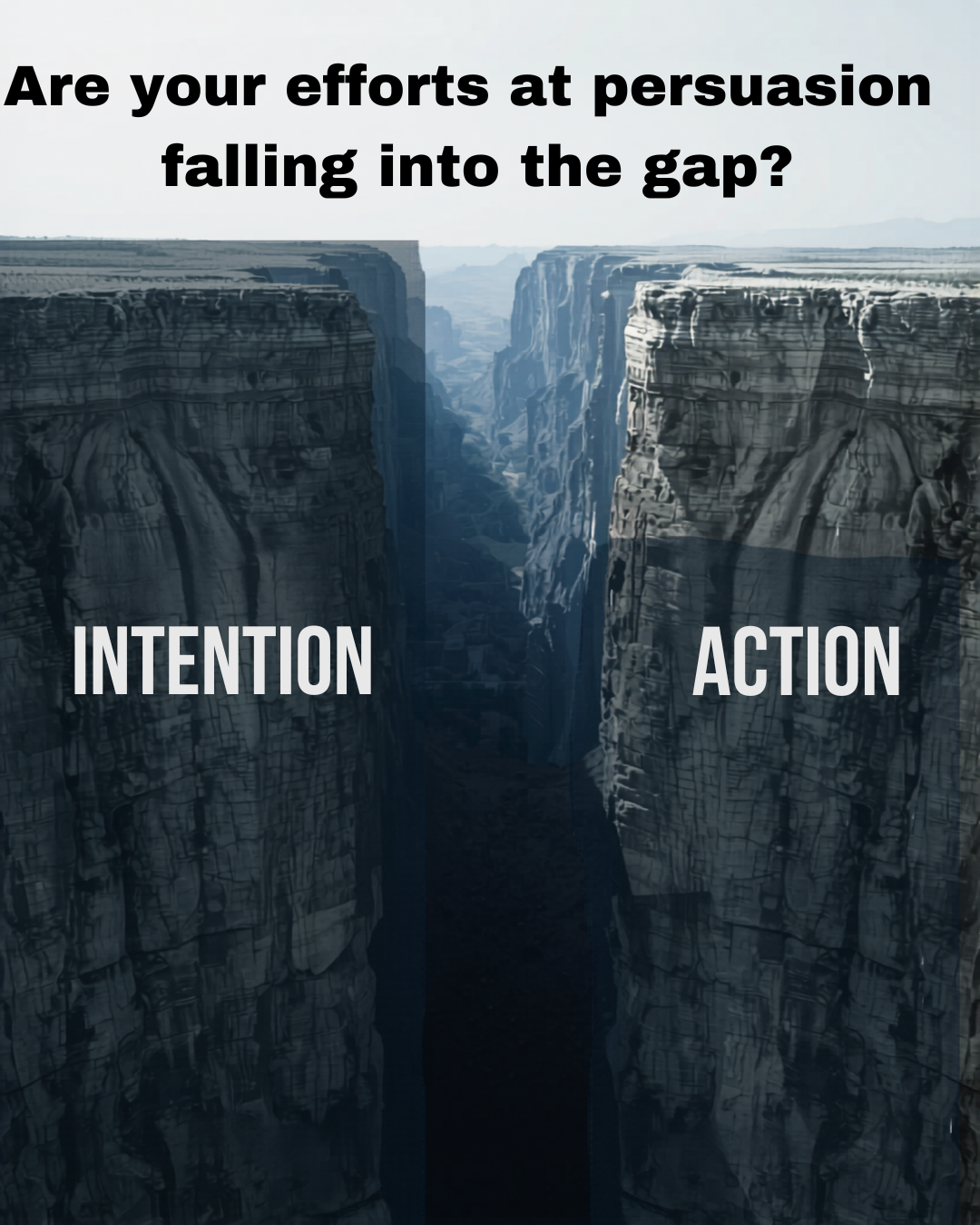
Next comes the biggest challenge. To get our audiences across what behavioral scientists call the “Intention to Action Gap.”
From unfulfilled New Year’s resolutions to abandoned goals to exercise more or eat better, there is a well-documented disconnect between what people intend to do and what they actually end up doing.

The gap isn’t evidence that the initial intention was insincere or dishonest. It is a structural feature of how our minds work and how that translates (or fails to translate) into behavior.
Indeed, most studies suggest that stated intentions are a surprisingly weak predictor of actual actions. For example, in health behavior research, roughly half the people who intend to act on a health goal fail to do so.
Finding ways to narrow the Intention to Action Gap is fundamental to persuasive messaging. Let’s examine five key ways to achieve that objective.

1. Focus on implementing the intention.
Peter Gollwitzer is a key figure in the study of the relationship between intention and action. His research can be summed up like this. Vague intentions tend to go unfulfilled. Intentions backed up by a specific plan to act on them result in action at a much higher rate.
“I will donate to the food bank” is far weaker than “When I get paid on Friday, I will go to the food bank’s website and donate $25 before I do anything else.” Research suggest that implementation intentions can double or triple follow-through rates.
In one British study, three groups were encouraged to exercise in the following two-week period. The control group was told to just record the times they exercised.
A second group was provided with motivating information about the health benefits of exercise. The third group was told to make a specific plan about exactly when and how they would exercise over the two-week period.
About 40% of the first two groups followed through on exercising. The motivating information had little impact. But 90% of those asked to come up with an implementation plan went on to execute it.
One of the most compelling nonprofit examples of this dynamic is in get-out-the-vote efforts. In the months ahead, we will see smart GOTV campaigns built around “Make a plan to vote” messaging.
2. Answer the “Why Now?” question.
“I’ll do it later.” The human instinct to defer doing something is one of the most significant reasons people fall into the gap. It’s not enough to persuade our audiences to develop an intention to do something. Whenever possible, we have to convince them to immediately act on that intention.
It is important to examine your messaging and make sure you haven’t left the “I can get to this later” door open. This is especially true for causes that work on problems requiring long-term solutions.
You have to have a compelling answer to the “why now?” question. If your audience can reasonably conclude that, while important, the action you’re asking them to take can be comfortably deferred, too many people will take that option.
3. Eliminate friction.
Amazon’s “Buy Now” / 1-Click purchasing is a familiar example of this dynamic. It seeks to eliminate the gap between intention and action by removing friction at the decisive moment.
Every point of friction is an opportunity for someone to fall into the gap. A prime example of this is monthly giving pledges. A relationship based on one-time gifts requires you to navigate the Intention-to-Action Gap each time you seek another gift.
But a monthly giving request only takes bridging that gap once. It can take a single moment of excitement and convert it into long-term commitment.
Even short of sustainer programs, it’s crucial to examine your messages and ask these two questions. “Where might someone hesitate in taking the action I am seeking?” “And how can I eliminate or reduce that point of hesitation?”
4. Link identity to action.
As I’ve noted in other contexts, there is a powerful difference between just asking someone to take an action and locating that action as an expression of that individual’s personal identity.
People give, volunteer, vote, and take other actions to affirm their sense of who they are and their commitment to acting on their beliefs. There is a big difference between asking someone “What are you going to do?” and asking them, “Who are you going to be?”
You can narrow the Intention to Action Gap in two ways.
First, by framing the action you want your audience to take as a way to express their identity. But also, by gently implying that failure to act is inconsistent with the identity they claim.
5. Deploy social proof at the point of decision.
Invoking social proof is one of the most effective ways to encourage people to act on their intention. Especially when your audience is unsure of what to do, they look for cues in what other people they respect and identify with are doing.
It’s why we so frequently see “2,432 people have bought this item in the last 24 hours” messages when online shopping.
The key is to invoke social proof at exactly the right moment. And that moment is as close to the point of decision as possible.

In my own writing, I find it really helpful to think about bridging the gap between intention and action. It helps expose weaknesses in your line of argument and heightens the persuasiveness of your message. I hope you’ll give it a try.