
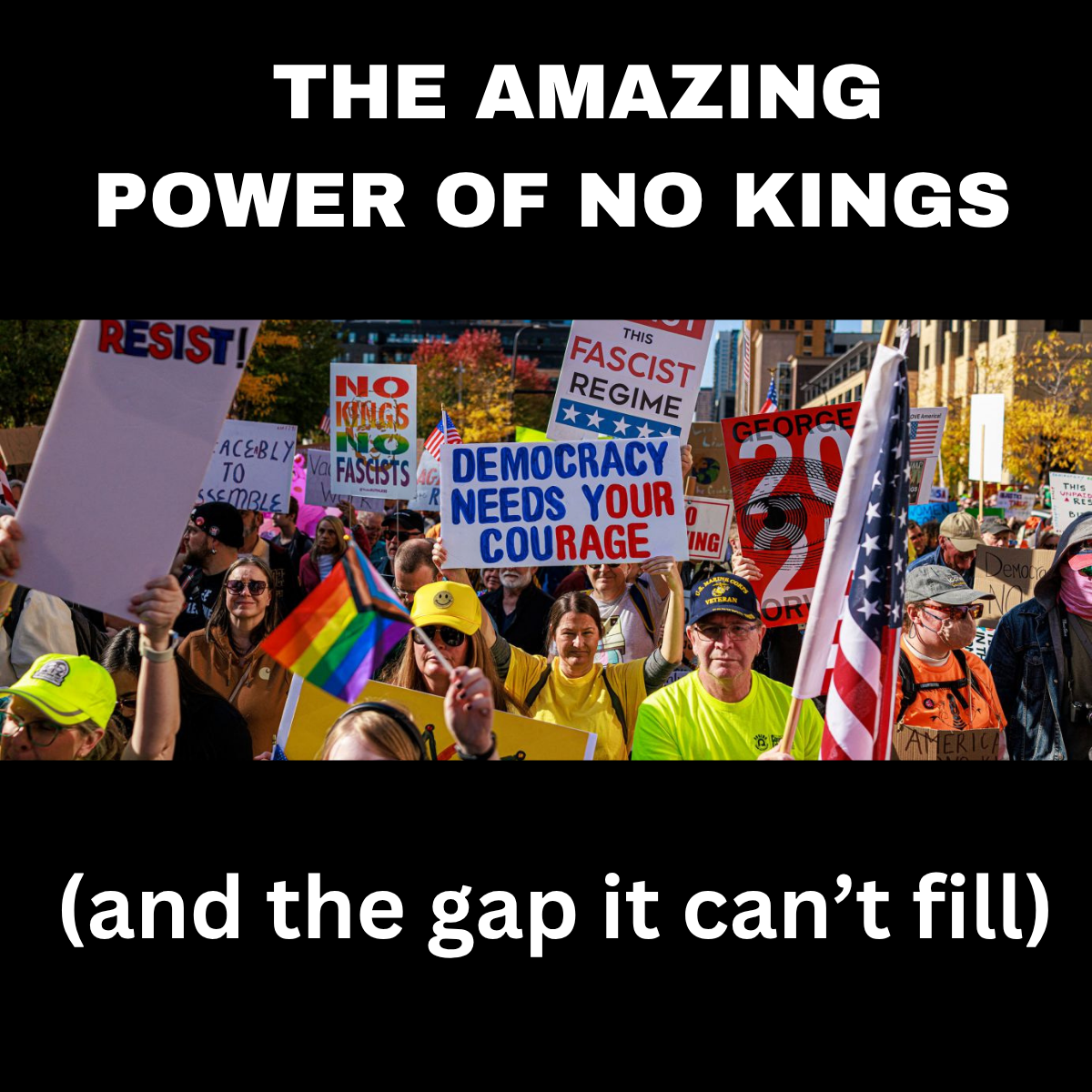
Wow. Eight million people taking to the streets in the largest protest demonstration our country has ever seen. When the history of the Trump era is written, the strategic brilliance and organizing prowess of the No Kings movement may well
be cited as the turning point that saved democracy.
But making history, refusing to yield and helping demonstrate the power of collective action hasn’t insulated the No Kings movement from skepticism.
But is it really having an impact?
Both in the lead up and in the aftermath of last Saturday, a skeptical undercurrent started to appear in media coverage. Sure, the pundits and commentators note, these are big numbers and people seem excited to be out there.
But have the three No Kings Days been just momentary “feel good” moments without really moving the dial on the country’s direction?
First of all, No Kings organizers have been clear from the start that the big No Kings Day events shouldn’t be seen in isolation. They are high-profile media events, but also hopefully launching pads for ongoing local organizing.
That said, No Kings Days themselves have mattered for very important reasons.
Tyrants succeed by keeping their opposition isolated. Trump and his allies have worked hard to convince us resistance to his all-out assault on our democracy is futile.
With too many Democratic leaders mumbling and cowering, No Kings has been there refusing to yield, helping demonstrate our collective power rather than giving in to despair and isolation. When the Democratic base couldn’t count on their own Party’s leaders to show some courage, No Kings has been there to fill the void.
So yes, No Kings is having an impact, a decisive one. That said, as we enter the run-up to November’s elections, we have to be alert to where and how No Kings can have an impact.
Attention Turns To The Midterm Elections.
Now, with the third No Kings Day in the history books, attention will begin to focus even more sharply on November’s midterm elections. It’s a date that has long been understood as the best chance to, at least in some degree, rein in Donald Trump’s power for the final two years of his presidency.
Democratic victories in November depend on a two-part strategy:
- Mobilization efforts to create massive turnout of the Democratic base
- Persuasion efforts to win the support of working-class voters who have drifted away from the Democratic Party.
One hopes the No Kings movement will devote a great deal of its energy and attention to mobilizing the Democratic base and to aggressively protecting the integrity of November’s elections. But when it comes to persuading working-class voters, that’s a task No Kings isn’t really positioned to help with.
The Electoral Gap No Kings Can’t Fill
No Kings has excelled at mobilizing people who see November’s election as a make-or-break opportunity to defend democracy, the Constitution, and the rule of law. But winning in November requires also attracting support from people who look at the election through a different lens.
Persuadable working-class voters see the election in more personal terms. They worry about keeping their head above water economically, paying for health care, gas and groceries.
It’s going to be up to Democratic candidates to convince these voters that they know what their families are going through and that they have workable ideas for delivering the help they need.
The Trump-centric No Kings message about defending democracy won’t resonate with these voters. But their decisions to vote Democratic in November could spell the difference between success and failure.
This isn’t an indictment of the No Kings strategy. Far from it. It’s just a recognition that we live in a complicated country and winning electoral strategies meet people where they are.

As I said at the outset, I believe history will credit the No Kings movement with a pivotal role in turning back a vicious assault on our democracy. And as is so often the case, the electoral victories that helped repel that assault will have complicated roots.