Back in my political consulting days, I was advising the campaign of Arthur Eve, a legendary progressive leader seeking to become the first Black mayor of Buffalo, New York.
Jesse Jackson was coming to town to endorse Eve and I labored over the script for a 30-second radio spot he would record after a big press event. When Jackson arrived at the recording studio, he said “That’s okay, I won’t need that.” He sat down at the mike and effortlessly recorded an inspirational, perfectly timed message.
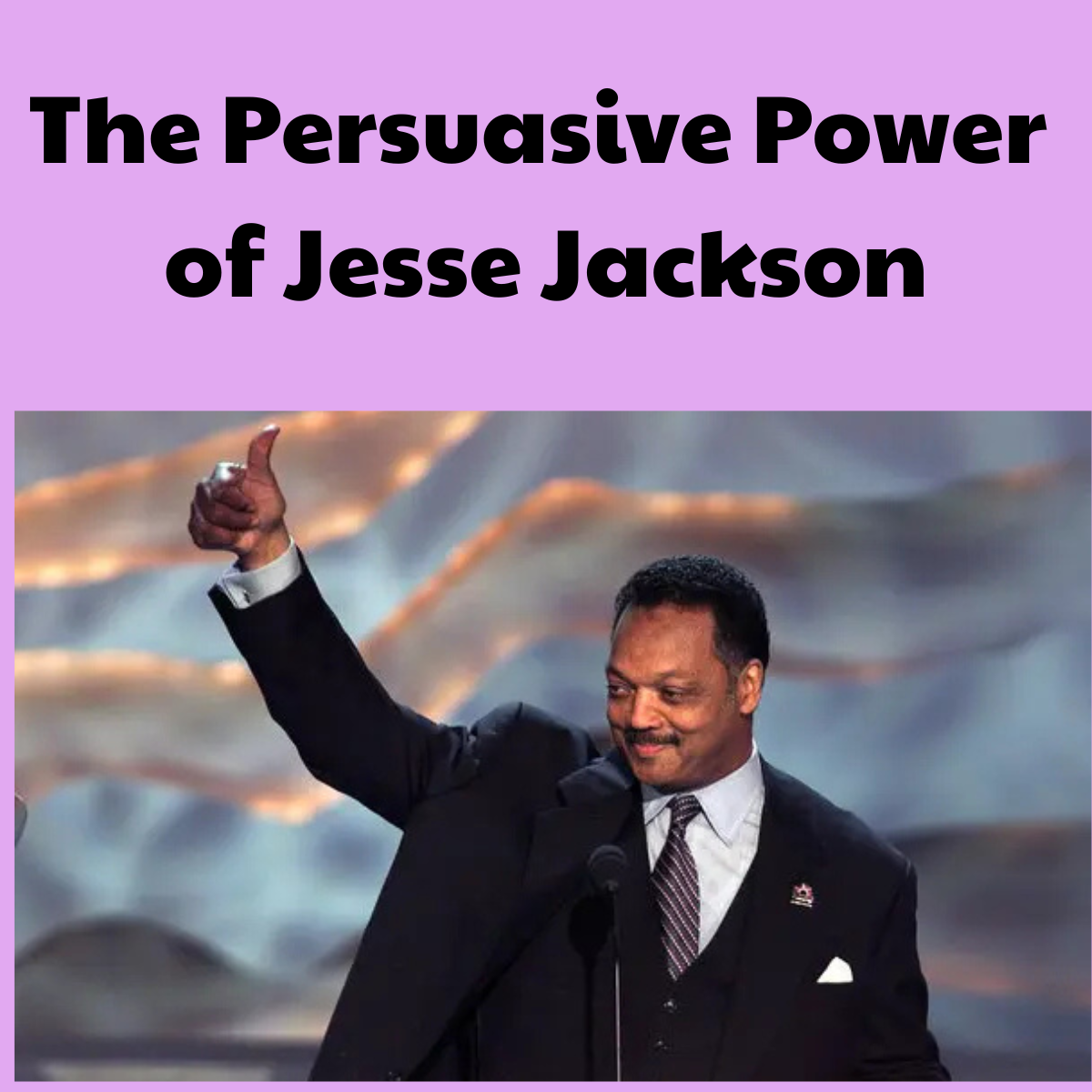
It was my personal glimpse into the persuasive power of one of our greatest messengers.

Decades after they were delivered, Jackson’s historic speeches at the 1984 and 1988 Democratic conventions remain masterpieces in the art of persuasion.
Today, in the aftermath of Reverend Jackson’s passing, let’s look at a few of the messaging techniques at the heart of his persuasive powers.
But first this: We mustn’t forget that Jackson was much more than an extraordinary orator. He was an organizer, a protest leader, a shaper of public opinion and popular culture and a vital bridge between the Martin Luther King Jr. and Barack Obama generations.

A couple of weeks ago, I highlighted the stirring wartime speeches of Winston Churchill. He learned his craft as a serious student of rhetoric. Jackson’s rhetorical power rose from different roots. An ordained Baptist minister, Jackson drew on the powerful Black southern preaching tradition.
As he once said: “I’ve never really felt there was much difference between my speeches and sermons — different approaches to achieve the same thing: conveying the good news.”
There’s no better example than Jackson’s iconic “I Am Somebody” call-and-response:
“I am somebody. I may be poor. But I am somebody. Respect me. Protect me. Never neglect me, I am somebody.” Each phrase echoed back by his audience, turning one man’s speech into a collective expression of dignity and a demand for respect.
Takeaways:
Jackson persuasively did all of three of these things with his signature call and response.

Perhaps the defining project of Jesse Jackson’s political career was the effort to build a broad Democratic coalition. As Bernie Sanders noted in a 2024 tribute, “Jesse Jackson’s contribution to modern history is not just bringing us together. It’s bringing us together around a progressive agenda.”
In pursuit of that goal, Jackson relied on two powerful metaphors. The first is the rainbow – many individual colors brought together to create an even more beautiful whole.
“Our flag is red, white and blue, but our nation is a rainbow — red, yellow, brown, black and white — and we’re all precious in God’s sight.”
But in many ways, the more interesting metaphor Jackson used was the quilt:
In 1984, he described it this way:
“America is not like a blanket – one piece of unbroken cloth, the same color, the same texture, the same size. America is more like a quilt – many patches, many pieces, many colors, many sizes, all woven and held together by a common thread. The white, the Hispanic, the black, the Arab, the Jew, the woman, the native American, the small farmer, the businessperson, the environmentalist, the peace activist, the young, the old, the lesbian, the gay and the disabled make up the American quilt.”
Four years later at the 1988 Convention, Jackson expressed it in even more vivid and personal terms:
“When I was a child growing up in Greenville, South Carolina, and grandmama could not afford a blanket, she didn’t complain and we did not freeze. Instead she took pieces of old cloth – patches, wool, silk, gabardine, crockersack – only patches, barely enough to wipe off your shoes with. But they didn’t stay that way for very long. With sturdy hands and a strong cord, she sewed them together into a quilt, a thing of beauty and power and culture. Now, Democrats, we must build such a quilt.”
Takeaways:

A third Jackson technique that warrants our close attention is his ability to reframe his opponent’s argument to expose its weakness.
In the 1980s, Ronald Reagan and the Republican Party were deeply invested in promoting “trickle-down economics.” The theory, if it can be called that, was that government investing in the wealthy was ultimately the way to elevate everyone’s economic fortunes.
Using peoples’ familiarity with a well-known folk hero, Jackson exposed the true intent and impact of the Republican approach:“Reaganomics — based on the belief that the rich had too little money and the poor had too much. So they engaged in reverse Robin Hood — took from the poor, gave to the rich, paid for by the middle class.”
Takeaways:

Just quick examples of a few other methods of persuasion Jackson deployed:
Repetition: “They catch the early bus. They work every day. They raise other people’s children. They work every day. They clean the streets. They work every day. They drive dangerous cabs. They work every day. They change the beds you slept in in these hotels last night and can’t get a union contract. They work every day.”
“America must never surrender to malnutrition… We must never surrender to illiteracy… We must never surrender to inequality…”
Alliteration: “My constituency is the desperate, the damned, the disinherited, the disrespected, and the despised.”
Rhyming: “Down with dope, up with hope.” “Put hope in their brains and not dope in their veins.”
And a final note: Jesse Jackson’s power of persuasion is best appreciated not as words on a page, but in live images on video. Here are YouTube links to his 1984 and 1988 convention speeches. They’re well worth watching and studying.
1984: https://www.youtube.com/watch?v=nGJ7btYJPPA1988: https://www.youtube.com/watch?v=6RCARIpVDLU